This session, I reached dungeon Level 10 and character Level 15. I still have not experienced a character death. The mechanics of the game haven't changed since my previous entries, so all I have is a bunch of miscellaneous things to tell you:
- As is often the case with me and roguelikes, I struggle to effectively use missile weapons. I recognize their importance to effective tactics, but I hate having to swap them in and out. Angband gives an "off-hand" slot for exactly that purpose, but I have to switch to my pick-axe so often that prefer to keep that there. I've been mostly using wands in lieu of missile weapons when I really need to hit something from afar.
- The creators of this game really like slimes, jellies, molds, and other icky things. It seems like half the enemies are some variety thereof.
- Lots of enemies can poison, but so far they've only been capable of short-duration poisoning, such that it wears off before it's worth using "Slow Poison," let alone "Neutralize Poison."
- I was well into the game before I realized that the number of experience points that you get for each enemy is dependent Qantas Credit Card partly on your level. It is possible to get less than one experience point for a foe. For instance, at Level 13, I only got 0.23 experience points for killing a giant louse. At Level 15, it was only 0.20.
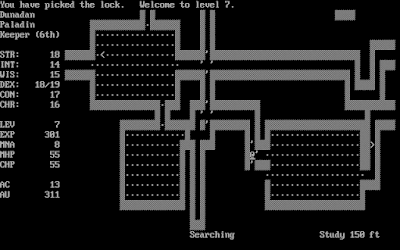 |
Picking a lock puts me over to the next level.
|
- Lots of things deliver experience, including casting spells for the first time, picking locks, and disarming traps. At 10 experience points, disarming traps is more rewarding than most monsters on the levels.
- There are classes of creatures that, in the game's own words, "breed explosively," meaning that it's hard to kill them faster than they appear. Such creatures include giant lice and worm masses Qantas Credit Cards of several colors, one of which is invisible. I sometimes have to abandon dungeon levels to their infestation. This is less of a problem than it is in roguelikes where dungeon levels are permanent.
 |
I can't kill the louses fast enough to keep up.
|
- One of the most useful features of Angband is found in its textual descriptions of monsters, which you can call up with the slash (/) key. The description slowly fills in as you experience more of the monster's special abilities and defenses.
 |
This is a pretty awesome feature.
|
- Monsters are denoted by both uppercase and lowercase letters and color. The letter indicates the class of monster and the color indicates the specific type, although some monsters only Qantas Points Credit Card have one type. For instance, "j" is the letter used for jellies, which include blue oozes, blue jellies, yellow jellies, silver jellies, green oozes, and white jellies. Uppercase letters seem to denote more difficult monsters, to the extent that I haven't met most of them. These include Ancient (D)ragons and (V)ampires.
- You occasionally run across a unique capital-lettered monster. I've met three: Fang, Farmer Maggot's dog (C); Grip, Farmer Maggot's other dog (C); Mughash the Kobold Lord; and Bullroarer the Hobbit. That last bastard Qantas Cards got about six actions per round, stole my money and items frequently, and disappeared in a puff of smoke like a rogue. He was immune to the effects of wands. It took me three Potions of Heroism, one Potion of Speed, and one Potion of Berserk Strength to finally kill him. Mughash had no special attacks but hit hard and had a lot of hit points. I had to "Portal" away from him several times, heal, and re-engage before I finally killed him.
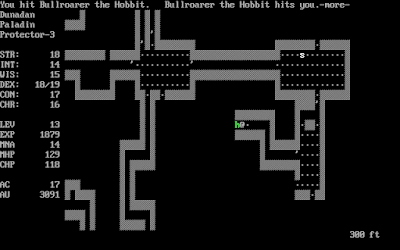 |
Fighting a named NPC. I think it's safe to say that the developers took names from Tolkien but not the actual personality of the characters.
|
- I guess Fang, Grip, and Bullroarer are all Tolkien characters. The game also has "snaga," which I now understand is a term for the non-Uruk Hai orcs. The movies never made me understand who was an orc, who was a goblin, and who was an Uruk Hai.
- The letter "p" seems to be used for the most enemies (people), including novice rangers, novice warriors, novice priests, novice mages, novice archers, novice paladins, novice rogues, battle-scarred Qantas Rewards Credit Card veterans, mean-looking mercenaries, aimless-looking merchants, singing happy drunks, squint-eyed rogues, mangy-looking lepers, pitiful-looking beggars, village idiots, boil-covered wretches, blubbering idiots, and filthy street urchins.
- In the place of mimics, the game has "creeping coins." They make you think they're piles of gold, but then they attack you. These same enemies could be found in Wizardry, but they make less sense there because the mechanics of that game didn't allow you to be fooled by piles of money. Thus, if you told me that Wizardry adopted them from some other source, that would make sense to me, except I can't find any evidence for that source.
- Not all monsters try to kill you. A lot just chill where you found them, only attacking if you come within range and threaten them. (Oddly, the ostensible monster "alignment" has nothing to do with this. Paladins attack my paladin with abandon.) My list of monsters to avoid includes green oozes Frequent Flyer Credit Cards Qantas (release gas that damages your equipment), blue oozes (damage your equipment with frost), giant salamanders (set you on fire, which can destroy scrolls), red naga (drain strength), and rogues and halflings (steal your stuff).
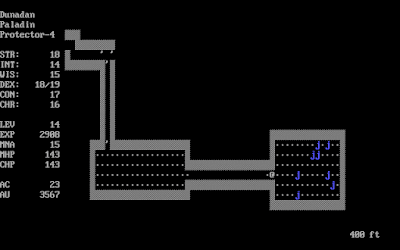 |
Maybe I'll leave this room alone.
|
- I get my strength drained a lot. Fortunately, stores back in town sell Potions of Restore Strength. Sometimes they don't have it in stock when I desperately need it. I often go down in the dungeon and just wait a couple hundred turns until the stocks change.
- SHIFT-S, which turns on searching permanently, Qantas Credit Card has helped a lot with searching. A lot of things turn it off, though, and I often forget to turn it back on.
- I have found a ton of Wands of Confuse Monster, and they're really useful. They not only make monsters bumble around randomly, they also forget to use their special attacks.
- I have found several chests, but I can't figure out any way to put things into chests.
- Because of the above problem, inventory gets full fast. Usually when I have to warp back to town it's because of a full inventory rather Qantas Credit Cards than any particular danger.
- The haggling mechanic in shops got old fast. I enabled the option to turn it off, and I almost always get better deals now anyway.
 |
The game bargains for me automatically.
|
- Selling unknown items identifies them. While shopkeepers won't buy bad items (e.g., Scrolls of Darkness, Potions of Weakness) or cursed items, they will often take a chance on unknown items. If they turn out to be bad, the shopkeeper usually Qantas Points Credit Card screams or weeps or yells at you.
- If you carry an unidentified item, you slowly learn at least some of its properties over time.
- Whatever was stopping me from learning new prayers last session eventually went away. I now have "Detect Evil," "Cure Light Wounds," "Bless," "Remove Fear," "Call Light," "Find Traps," "Detect Doors/Stairs," "Slow Poison," "Blind Creature," "Portal," "Cure Medium Wounds," "Chant," "Sanctuary," and "Remove Curse." I get the most use Qantas Credit Card out of the healing spells and "Call Light," but "Portal" (which does the same thing as a Scroll of Phase Door) has saved me from a couple of deaths.
 |
I prepare to "Portal" away from some orcs who have nearly killed me.
|
- "Detect Invisibility" is somewhat useless in this game. It only shows the presence and positions of invisible characters for one quick round.
 |
I won't see those worms anymore after I acknowledge the message.
|
- Since I got the "good feeling" about the level in the last entry, and found the Shining Phial, it hasn't happened again.
- There is a "wounding" system distinct from the loss of hit points. I'm not sure what it does, however, because any wounds I've received so far have healed within Qantas Cards a couple of rounds.
- Scrolls of Words of Recall take about 30 rounds to work.
- Scrolls of Identify are, as usual, some of the most useful items in the game. It always enrages me when I get back to town and there are none for sale.
- Your house in town is a really useful place to stockpile things you want to save but don't need just yet.
For inventory, my main weapon is a longsword. I found a pretty good one with +2 to hit, +1 to damage. Having "settled" on it, I've been periodically buffing it with Scrolls of Enchant Weapon, so now it's up to +8 / +5. I'm wearing an iron helm, leather scale mail, a large metal shield, a set of gauntlets, a pair of hard leather boots, and a cloak, none of which I'm particularly wedded to, so I haven't been doing the same with Scrolls
Qantas Rewards Credit Card of Enchant Armor (which are less plentiful anyway). I have a Ring of Searching +10 and a Ring of Protection +8. So far in the game, I haven't had a lot of other ring options. I had a Ring of Feather Falling for a while, but you don't fall that often. A Ring of Slow Digestion seems to be a waste in a game where food is plentiful.
 |
My equipped inventory at the end of this session.
|
I ended my last entry asking what you particularly liked about what I felt was a somewhat bland game. What I can say now is that the game satisfies me in a few areas. The first is the constant improvement loop as you find new equipment,
Frequent Flyer Credit Cards Qantas acquire gold, and level up. We meet so many games that regard character development as an afterthought; roguelikes have always understood its importance. Second, I like how the number of potential combat tactics are growing as I gain spells and equipment.
Third, I think the "town level" really adds a dimension that roguelikes of the
NetHack line lack. Finally, I like that you can essentially control the pace at which the game becomes more difficult.
NetHack, though a better game, is also a very claustrophobic game. Every time you start a session, you take a deep breath, enter the dungeon, and don't quite feel safe until you leave. When death comes, it often feels like a relief from the constant tension.
Angband, with its easy first levels and ability to retreat to town, is a much more casual game. You don't play every session in a cold sweat.
As I mentioned above, I did make it to Level 10, but I was getting ahead of myself. I nearly died a couple of times at the hands of large groups of hill orcs. Keeping the dungeon level to about half my character level seems a good strategy if I want to continue not to die. At this point, that's more important to me than making quick progress, although that may change as the game drags on.


Comments
Post a Comment